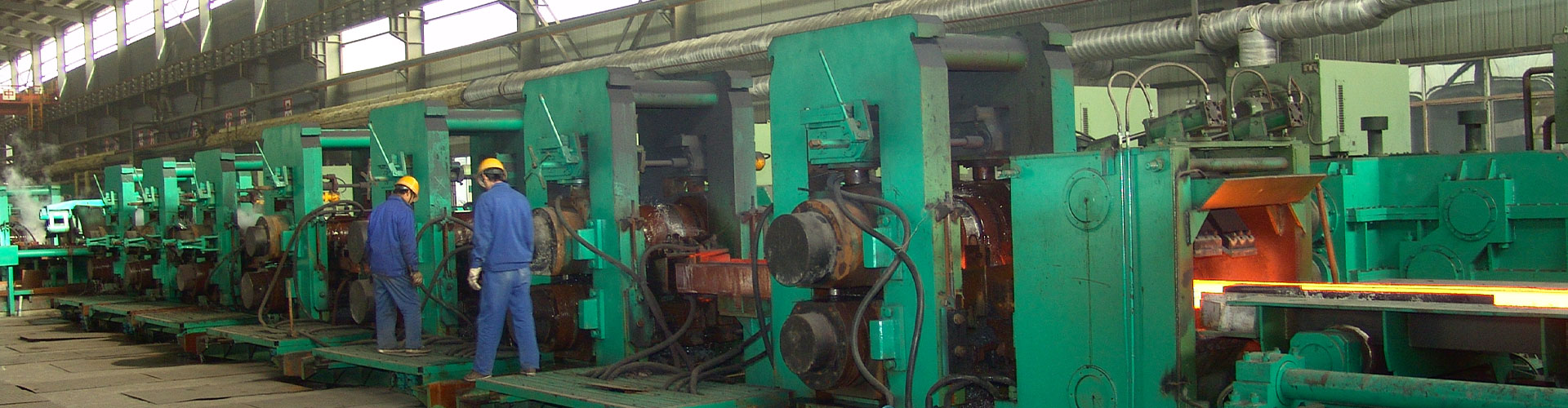
Traditional four-high rolling mills are widely used in strip rolling production. However, market requirements for strip dimensional accuracy, flatness and surface quality continue to rise. As a result, the limitations of four-high mills become more obvious. They have limited flatness adjustment capacity and serious edge thinning problems. Therefore, they cannot fully meet the demand for high-precision, wide and ultra-thin strips. The six-high HC rolling mill is an innovative rolling equipment. It effectively compensates for the shortcomings of four-high mills and supports higher-quality cold-rolled strip production.
The six-high HC rolling mill uses a unique three-layer roll structure. It is equipped with movable intermediate rolls and hydraulic work roll bending devices. The mill combines intermediate roll axial shifting with work roll bending adjustment. This coordinated control optimizes roll gap profile and strip flatness during free schedule rolling. It also reduces strip edge drop and improves rolling accuracy. For these reasons, the development of six-high HC rolling mills has advanced strip flatness theory and control technology. Today, they are widely used in domestic high-precision cold rolling and tempering lines.
## Main Types of Six-High HC Rolling Mill
The basic six-high HC structure has developed into several industrial models. These variants adapt to different steel grades, strip sizes and production processes. The most common types are HCM, UCM and UCMW six-high rolling mills.
### HCM Six-High Rolling Mill
The HCM six-high rolling mill is the basic HC model. It adds a pair of intermediate rolls between the work rolls and backup rolls of a traditional four-high mill. Its core feature is the axially movable intermediate roll. It also uses positive and negative hydraulic bending of the work rolls. The mill adjusts flatness through intermediate roll shifting and work roll bending. It suits conventional hot rolling, cold rolling and tempering processes.
### UCM Six-High Rolling Mill
The UCM six-high rolling mill builds on the HCM structure. It retains intermediate roll shifting and work roll hydraulic bending. It also adds an independent intermediate roll bending device. The dual bending control improves flatness adjustment accuracy. This model works well for wide and thin strips. It is one of the most widely used models in domestic cold rolling production.
### UCMW Six-High Rolling Mill
The UCMW six-high rolling mill is a higher-performance HC model. It allows axial shifting of both work rolls and intermediate rolls. It also supports hydraulic bending for both roll types. This multi-degree-of-freedom adjustment improves roll gap control. The mill can produce ultra-thin strips efficiently. It is especially suitable for high-precision ultra-thin cold-rolled strips and high-strength alloy strips.
## Core Technical Characteristics of Six-High HC Rolling Mill
Compared with four-high mills, the six-high HC rolling mill has clear technical advantages. It improves roll gap rigidity, flatness control and edge drop performance. It also supports energy-efficient rolling. The main characteristics are summarized below.
### Improve Roll Gap Rigidity by Reducing Harmful Contact
The four-high mill has a harmful contact area outside the strip width. Roll contact beyond the strip width causes uneven roll deflection. This deflection harms strip flatness. The six-high HC rolling mill reduces this harmful contact area. It does so through precise axial shifting of the intermediate rolls. This adjustment optimizes roll system contact stress and improves roll gap rigidity.
### Optimize Bending Force and Extend Bearing Life
The work roll ends in a six-high mill are in a cantilever state. This structure makes work roll edge deformation more sensitive to bending force. As a result, the mill can achieve the same flatness control with smaller bending force. Lower bending force reduces load on work roll bearings. It also decreases fatigue wear and extends bearing service life.
### Strengthen Flatness Control Through Dual Regulation
The six-high HC rolling mill uses two control methods together. These methods are intermediate roll axial shifting and hydraulic roll bending. They complement each other and provide flexible strip crown and flatness control. The mill can reduce common defects such as center wave, edge wave and warping. It also helps solve the edge drop problem often seen in four-high mill rolling.
### Use Cylindrical Rolls to Lower Production Cost
Many four-high mills require pre-ground convex work rolls. By contrast, six-high HC rolling mills can use cylindrical work rolls and backup rolls. This approach simplifies roll grinding and reduces grinding frequency. It also lowers spare roll inventory and maintenance work. As a result, total production and maintenance costs decrease.
### Support Large Reduction and Efficient Rolling
The six-high HC rolling mill has a rigid roll system and flexible adjustment ability. These features allow it to use smaller diameter work rolls. Smaller work rolls reduce single-pass rolling force. They also enable larger reduction and fewer rolling passes. This combination improves production efficiency and material yield while saving energy.
## Working Principle of Six-High HC Rolling Mill
The six-high HC rolling mill solves the roll deflection problem of four-high mills. It does so through a three-layer roll control structure. In a four-high mill, roll contact beyond the strip width causes excessive work roll deflection. This deflection changes the roll gap profile and increases edge thinning. It also makes the mill more dependent on original roll crown.
The six-high HC rolling mill adds movable intermediate rolls between work rolls and backup rolls. During production, the system adjusts the intermediate roll axial position according to strip width. This adjustment reduces harmful contact outside the strip width. It also limits abnormal work roll deflection and improves uniform roll gap distribution.
The mill works together with a full hydraulic screwdown system and AGC system. These systems provide fast thickness control. The hydraulic bending device fine-tunes local work roll deformation. The intermediate roll shifting optimizes the overall roll gap profile. Together, they control strip thickness tolerance and flatness precisely.
Modern six-high HC rolling mills also use computer control systems. These systems set process parameters automatically for different steel grades and strip sizes. They support high-precision and high-speed continuous rolling. They also improve finished strip surface quality, dimensional accuracy and flatness.
## Application Advantages and Industry Value
The six-high HC rolling mill is ideal for high-quality strip production. It improves flatness and reduces edge drop compared with four-high mills. It also raises production efficiency, reduces material loss and saves energy. Domestic large six-high rolling mills have been widely used in industrial production. They provide stable support for high-precision stainless steel strips, carbon steel strips and ultra-thin coated strips.
## Conclusion
The six-high HC rolling mill is a high-precision rolling equipment. It breaks through some limitations of traditional four-high mills. The mill achieves better flatness control and edge drop optimization. It does so through intermediate roll shifting and hydraulic bending coordination. The six-high HC rolling mill also offers high rigidity, high precision, low energy consumption and low maintenance cost. Therefore, it is widely used in high-quality cold rolling and tempering production. As strip quality requirements continue to rise, the six-high HC rolling mill will play an even more important role in the steel rolling industry.