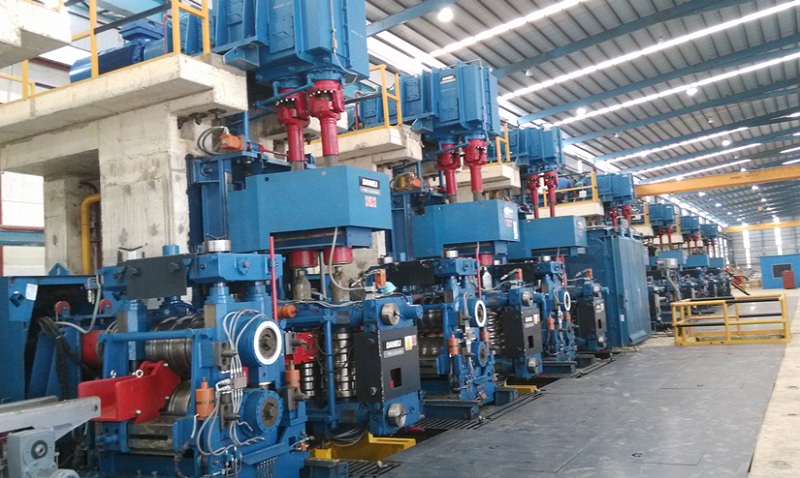
Selecting the right motor for a rolling mill is a critical engineering decision. The drive motor is the heart of the mill, and its power directly impacts production efficiency, energy consumption, operational costs, and the final quality of the rolled product. An undersized motor will fail to handle the load, leading to stalls and production losses, while an oversized motor results in unnecessary capital expenditure and lower energy efficiency. This guide provides a comprehensive overview of the basic methods and key considerations for choosing the appropriate motor power for your rolling mill operations.
1. Understanding the Mill’s Load Characteristics
The first step in motor selection is to analyze the load profile of the specific rolling mill. Rolling processes vary widely, and so do their demands on the drive system. We can generally classify them into three main categories.
Category A: Mills with Stable or Predictable Loads
These mills experience a relatively constant load during the rolling process, or the load changes in a predictable, non-drastic manner. Examples include the finishing stands of a hot strip mill or a cold rolling tandem mill operating at a constant speed.
- ✔Motor Choice: AC asynchronous (induction) motors are the most common and cost-effective choice for these applications. For very large mills where power factor correction is a concern, AC synchronous motors may be employed.
- ✔Selection Rationale: The stable load allows the motor to operate efficiently near its rated power. The selection process is straightforward, primarily based on calculating the steady-state power required for rolling.
Category B: Mills with High, Intermittent Peak Loads
This category includes mills like section mills or plate mills, where a heavy workpiece enters the rolls, creating a sudden, massive load (a peak or impact load), followed by an idle period before the next pass. Sizing a motor to handle this peak load directly would result in a very large and inefficient motor that is underutilized most of the time.
The Flywheel Solution: To manage these peaks, a flywheel is often installed in the drive train.
• During Idle Time: The motor speeds up the massive flywheel, storing kinetic energy.
• During Rolling (Peak Load): As the workpiece enters the mill, the immense load causes the drive system to slow down slightly. The flywheel releases its stored kinetic energy, assisting the motor in overcoming the peak load.
This system effectively “shaves” the load peaks, allowing for a much smaller, more efficient motor to be used, as it only needs to handle the average load.
Category C: Mills Requiring Reversing and Wide Speed Control
Reversing mills, such as blooming mills, slabbing mills, or Steckel mills, require the drive motor to rapidly accelerate, decelerate, and change direction. They also need precise speed control over a wide range.
- ✔Motor Choice: Traditionally, DC (Direct Current) motors have been the standard for these applications due to their excellent torque and speed control characteristics. However, modern AC motors paired with advanced Variable Frequency Drives (VFDs) are now a viable and increasingly popular alternative.
- ✔Selection Rationale: The motor’s capacity must be selected not just for the rolling load but also for the significant dynamic loads required for acceleration and deceleration of the massive rotating parts. The motor’s thermal capacity (ability to dissipate heat) during frequent start-stop cycles is a crucial consideration.
2. Core Parameters for Motor Power Calculation
Regardless of the mill type, the fundamental calculation of motor power revolves around determining the torque and speed required at the roll stand. The basic formula for power is:
Power (P) = Torque (M) × Angular Velocity (ω)
To find the required power, you need to calculate the rolling torque, which depends on several factors:
- ✔Rolling Force: The vertical force exerted by the rolls on the material. It is influenced by the material’s strength at rolling temperature, the amount of thickness reduction, friction between the roll and material, and the width of the material.
- ✔Lever Arm: The effective distance from the roll center at which the rolling force acts to create torque. It is a fraction of the contact length between the roll and the material.
- ✔Friction Losses: Power is also consumed to overcome friction in the drive system’s gearboxes, spindles, and roll neck bearings. These losses must be added to the power required for deformation.
- ✔Rolling Speed: The rotational speed of the rolls, which determines the production rate.
3. Simplified Calculation Example
Let’s walk through a simplified example to illustrate the process for a single pass in a hot rolling mill. Note that real-world calculations involve more complex models and software.
Input Parameters
| Parameter | Value | Description |
|---|---|---|
| Material | Low Carbon Steel | The material being rolled. |
| Initial Thickness (h1) | 30 mm | Thickness before the pass. |
| Final Thickness (h2) | 22 mm | Thickness after the pass. |
| Slab Width (w) | 1200 mm | Width of the material. |
| Work Roll Diameter (D) | 800 mm | Diameter of the rolls. |
| Rolling Speed (v) | 3 m/s | Exit speed of the material. |
| Avg. Material Resistance (k) | 150 MPa | Average resistance to deformation. |
Calculation Steps
- Calculate Contact Length (L):
L = sqrt( (D/2) * (h1 – h2) ) = sqrt( 400 * (30 – 22) ) = sqrt(3200) ≈ 56.6 mm - Estimate Rolling Force (F):
F = k * w * L = 150 N/mm² * 1200 mm * 56.6 mm ≈ 10,188,000 N or 10,188 kN - Estimate Rolling Torque (M): (Assuming lever arm is ~0.5 * L)
M = F * (0.5 * L) = 10,188,000 N * (0.5 * 0.0566 m) ≈ 288,272 Nm per roll. Total Torque for two rolls = 576,544 Nm. - Calculate Angular Velocity (ω):
ω = v / (D/2) = 3 m/s / 0.4 m = 7.5 rad/s - Calculate Net Rolling Power (P_net):
P_net = Total Torque * ω = 576,544 Nm * 7.5 rad/s ≈ 4,324,080 W or 4,324 kW. - Calculate Gross Motor Power (P_motor):
Assuming drive train efficiency of 85%, P_motor = P_net / 0.85 = 4324 kW / 0.85 ≈ 5,087 kW.
Based on this calculation, you would select a standard motor with a rating just above this value, for example, a 5,500 kW motor, to provide a safe operating margin.
4. Drive System Comparison: AC vs. DC Motors
The choice between an AC and DC drive system is a significant one, with each having its own set of advantages.
| Feature | AC Motor (with VFD) | DC Motor |
|---|---|---|
| Maintenance | Lower. No brushes or commutators to service. More robust construction. | Higher. Regular inspection and replacement of carbon brushes and commutator skimming are required. |
| Initial Cost | Motor is cheaper, but the high-power VFD can be expensive. Overall cost is often competitive. | Motor is more expensive and complex to manufacture. The drive (rectifier) is simpler. |
| Control Performance | Excellent with modern vector control VFDs, matching or exceeding DC performance. | Inherently excellent torque control and wide speed range, the historical benchmark for performance. |
| Size & Weight | More compact and lighter for the same power output. | Larger and heavier due to the commutator and brush gear. |
| Operating Environment | Better suited for harsh, dusty, or explosive environments due to its enclosed design. | Brush sparking can be a hazard in certain environments. More susceptible to contamination. |
Ultimately, the proper selection of a rolling mill motor is not a one-size-fits-all task. It requires a detailed analysis of the rolling schedule, material properties, and the dynamic requirements of the specific mill. By carefully considering the load characteristics and performing accurate power calculations, you can ensure the selection of a drive system that is powerful, reliable, and economically efficient for years of productive service.