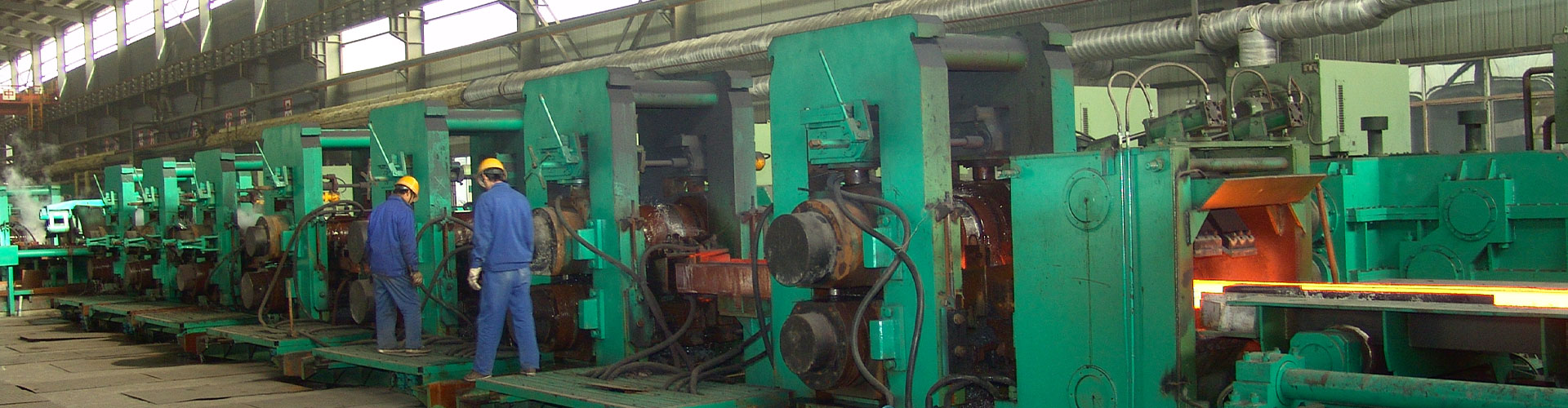
High-speed wire rod mills represent the pinnacle of modern long product rolling technology, delivering high productivity, exceptional dimensional accuracy, and superior surface quality for a wide range of steel grades. In this second part of the production process flow, we delve deeper into the critical stages that follow initial roughing—specifically focusing on intermediate rolling, preacabado, controlled cooling before final rolling, and the high-precision finishing and sizing operations that define today’s advanced wire rod lines.
Intermediate Rolling: Precision Through Micro-Tension Control
After the initial roughing passes, the heated billet enters the intermediate rolling section. This stage typically consists of six stands arranged in an alternating horizontal-vertical (平立交替) configuration. The key objective here is to reduce the cross-section further while maintaining tight dimensional control and minimizing internal stresses.
The rolling is performed under micro-tension conditions, meaning the interstand tension is carefully controlled to be just enough to ensure stable threading but not so high as to cause elongation or shape defects. This balance is crucial for achieving consistent ovality and diameter tolerance downstream.
At the exit of the intermediate mill, a No. 2 cizalla voladora trims the head of the bar. This operation removes any irregularities formed during acceleration or transient conditions. Importantly, in the event of a mill upset—such as a bar break or guide failure—the shear can instantly activate its “crop-and-scrap” function, cutting the strand into manageable pieces that are diverted to a scrap chute, preventing damage to downstream equipment.
Pre-Finishing Mill: Multi-Technology Integration for Stability
The pre-finishing section is where the process architecture becomes notably sophisticated. Modern high-speed wire rod mills employ a hybrid configuration of six stands, each optimized for specific mechanical and thermal demands:
- Stands 1–2: Closed-type roll stands, structurally similar to those in roughing/intermediate sections, offering robustness for larger reductions.
- Stands 3–4: Cantilevered roll ring stands, enabling quick roll changes and excellent rigidity at higher speeds.
- Stands 5–6: V-type top-cross (顶交式) se encuentra, designed for minimal deflection and precise profile control during near-finish passes.
To eliminate interstand tension and allow true free-passage rolling, the pre-finishing mill incorporates a total of five loopers:
- Three vertical loopers: located before the first stand, between stands 2–3, and between stands 4–5.
- Two side loopers: positioned before stand 3 and before stand 5.
Each looper is equipped with a high-response hydraulic actuator and monitored by laser or optical scanners that continuously measure loop height. This feedback drives real-time adjustments to stand speeds, ensuring the bar remains in a zero-tension state throughout the entire pre-finishing train. This is essential for preventing necking, twisting, or dimensional drift—especially critical when rolling low-carbon or microalloyed grades sensitive to strain variations.
A breakout shear is installed at the exit of the side looper before the final pre-finishing stands. In case of a downstream fault (p.ej., guide blockage or roll failure), this shear activates within milliseconds to isolate the problem zone, protecting the expensive finishing mill components.
Controlled Cooling Before Finishing: Thermal Management for Microstructure Control
Upon exiting the pre-finishing mill, the bar—now typically around Φ16–Φ21 mm—enters a critical thermal conditioning phase. Two water-cooling boxes (often referred to as “water tanks”) are positioned immediately after the pre-finishing exit. These are not simple spray headers; they form a closed-loop temperature control system.
Thermocouples measure the bar temperature in real time, and the system dynamically adjusts water pressure, flow rate, and coverage to achieve a target entry temperature into the finishing mill—usually between 880°C and 950°C, depending on the steel grade and desired final properties.
This step is vital for:
- Preventing excessive grain growth before final deformation.
- Enabling lower finishing temperatures for finer ferrite grain size in carbon steels.
- Optimizing phase transformation kinetics for high-strength low-alloy (HSLA) or cold-heading quality (CHQ) wires.
Following cooling, a pre-finishing flying shear trims the head once more. A set of pinch rolls (夹送辊) is also installed here—not for normal operation, but to assist in threading large-diameter products (p.ej., Φ12 mm and above) or to push the bar through during recovery from an upset.
Fundamentalmente, a side looper and breakout shear are placed just before the finishing mill entrance. If a fault occurs in the finishing train, this shear cuts the incoming bar, and a diverting switch (转辙器) routes the severed end into a scrap path where a dedicated scrap shear chops it into short segments for safe collection.
Finishing and Sizing: High-Speed, Low-Temperature, Laminación de alta precisión
The heart of the high-speed wire rod mill is its finishing train, which combines extreme speed with metallurgical precision. The standard configuration includes:
- 8 stands of V-type ultra-heavy-duty finishing mills
- 4 stands of reducing/sizing (减径定径) molinos
These stands feature several advanced design elements:
- V-type ultra-heavy roller boxes: Provide exceptional stiffness to withstand high rolling forces at low temperatures, minimizing roll deflection and ensuring roundness.
- Tungsten carbide cantilevered roll rings: Offer superior wear resistance and thermal stability, enabling consistent surface finish even at speeds exceeding 100 EM.
- Interstand water cooling: A dedicated water box between the 8th finishing stand and the first sizing stand allows final temperature adjustment just before the last deformation passes—key for controlling final austenite grain size and transformation behavior.
The mill uses a mix of roll box sizes to balance performance and maintenance:
| Roll Box Type | Cantidad | Diámetro de rollo | Función primaria |
|---|---|---|---|
| Standard Heavy-Duty | 10 | 230 mm | Main reduction in finishing stands |
| Compact Sizing | 2 | 150 mm | Final sizing and diameter control |
The number of actual rolling passes varies by product specification—typically between 2 y 12 pasa through the combined finishing and sizing section. For common commercial quality wire rod in the Φ5.5 mm to Φ7.5 mm range, the mill achieves a remarkable final rolling speed of up to 112 metros por segundo. To put this in perspective, that’s over 400 km/h—faster than most high-speed trains.
At these velocities, even minor imbalances can cause catastrophic vibrations. Por eso, all rotating components undergo rigorous dynamic balancing, and the entire mill foundation is isolated with vibration-damping mounts. Además, automatic roll gap adjustment systems (AGC) and real-time diameter monitoring via laser gauges ensure that dimensional tolerances stay within ±0.1 mm—even at full speed.
This combination of mechanical precision, thermal control, and intelligent automation allows modern high-speed wire rod mills to produce not only standard carbon steel rods but also demanding grades such as:
- SWRH82B (for prestressed concrete wire)
- ML35CrMo (for automotive fasteners)
- ER70S-6 (alambre de soldadura)
- Free-cutting steels (p.ej., 12L14)
Each of these requires tailored temperature profiles, reduction schedules, and post-rolling cooling paths—all orchestrated seamlessly by the mill’s process control system, which integrates data from hundreds of sensors along the line.
As global demand grows for higher-strength, limpiador, and more consistent wire rod, the evolution of these mills continues—toward even greater speeds, smarter diagnostics, and tighter integration with downstream processes like Stelmor or DLP controlled cooling lines. But the core principles remain: eliminate tension, control temperature, and maintain precision at every pass.