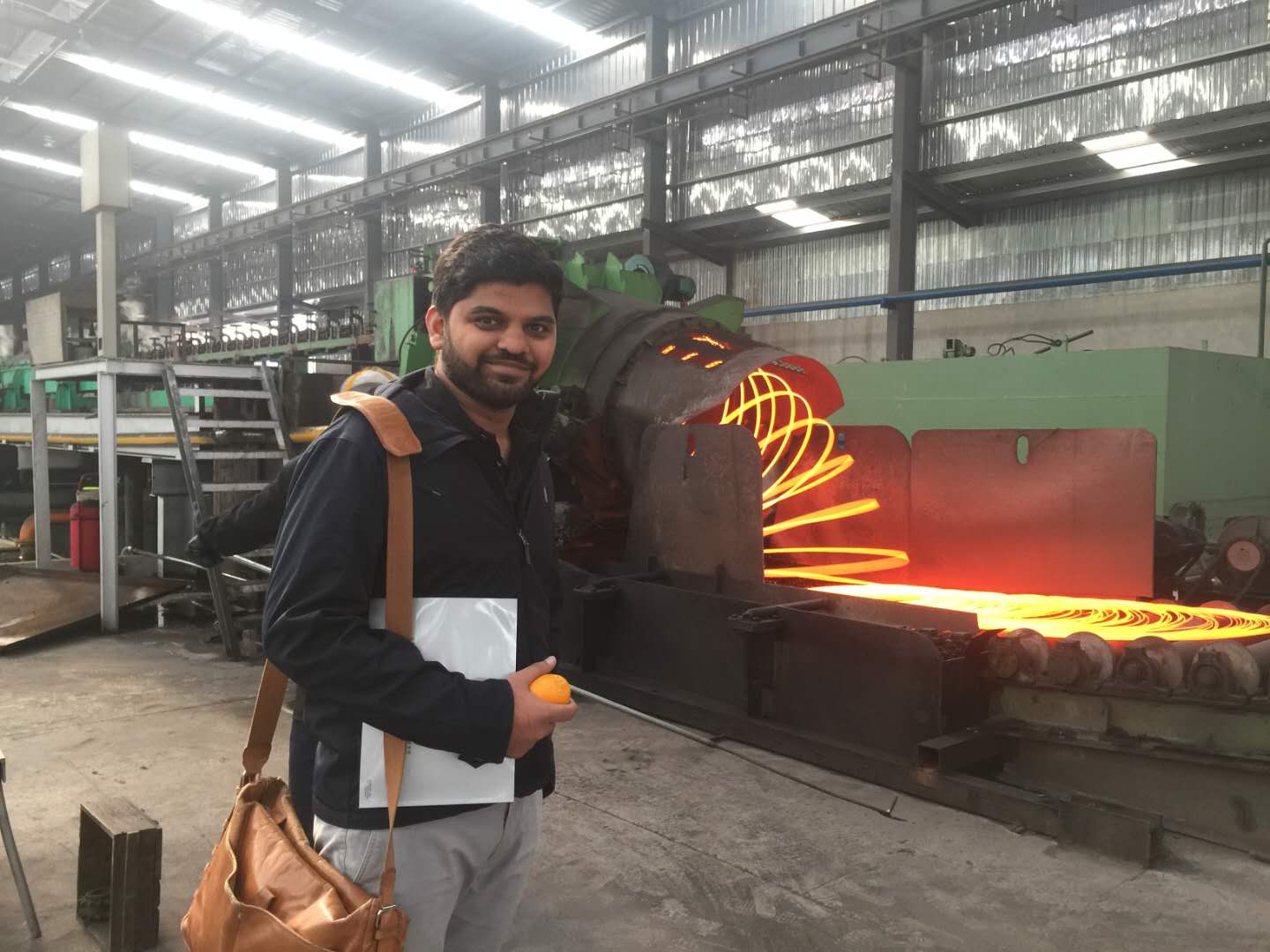
Los principales procesos de laminación de la línea de producción de molinos de alambrón son:
1) Palanquilla: La palanquilla utilizada en la línea de producción del molino de alambrón es principalmente palanquilla de colada continua., cuya longitud lateral es generalmente 120 ~ 150 mm, y la longitud es generalmente de aproximadamente 6 ~ 12 metros. En producción real, the quality of continuous casting billets is inspected by visual inspection, electromagnetic induction flaw detection, and ultrasonic flaw detection;
2) Heating Generally, a walking beam reheating furnace is used for heating. The heating requirements are less oxidative decarburization, no slab distortion, and no overheating or overburning. Modern high-speed wire rod mills have large and long billets, which require uniform heating temperature and a small temperature fluctuation range.
3) The cross-section of the rolled wire rod is relatively single, so the rolling mill is more specialized. Because the total extension of the billet to the finished product is large, the number of rolling stands is large, generalmente, 21 a 28, divided into rough, medium, and finishing rolling units. Actualmente, the exit speed of molinos de alambrón de alta velocidad has reached more than 100m / s.
4) Finishing Due to the high rolling speed of modern wire rod mills, the temperature drop during rolling is small, or even heating rolling. Por lo tanto, the temperature after finishing wire rods is very high. In order to ensure product quality, bulk coil cooling is required. There are pearlite-controlled cooling and martensite-controlled cooling according to the product application.
Its production process is as follows:
Billet shipment → batch weighing → stocking → loading before reheating furnace → billet quality inspection → single weighing → heating → rough rolling → cutting head and tail → middle rolling → pre-finishing (water cooling in the rolling room) → cutting head Tail → finish rolling (water cooling in the rolling room) → water cooling → spinning in loops → bulk cooling → collecting coils → cutting heads and tails → pressing and bundling → weighing and tagging → unwinding → storage