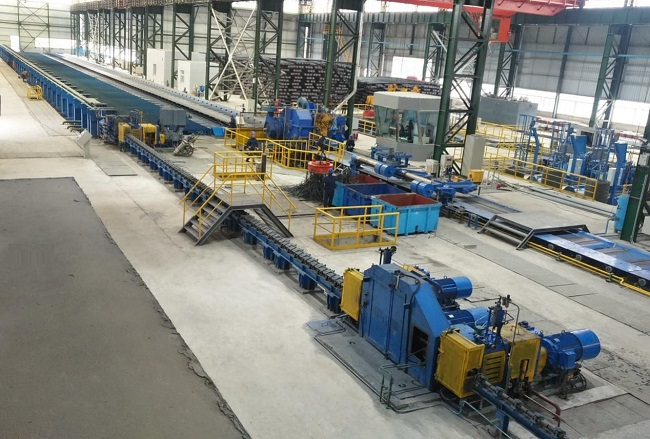
Processus de laminage de barres et sélection d'équipement
1. Sélection de la configuration du processus de laminage de barres
Pour barres laminées à chaud, le schéma de configuration du processus de laminage de barres est principalement divisé en laminage continu et en laminage semi-continu.
1.1 Laminage semi-continu
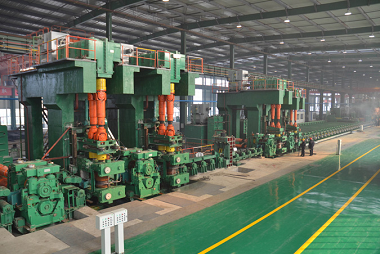
Un broyeur réversible à deux cylindres + laminoir continu (6 ou 8)sont disposés généralement. Le broyeur à deux cylindres est doté d'un dispositif de retournement avant et arrière pour l'acier et d'un manipulateur.. Le laminoir continu est généralement plat/vertical, ou disposé verticalement/à plat. La raison pour laquelle il est disposé verticalement/à plat est que nous n'avons pas besoin de tourner l'acier lorsque le matériau entrant est un flan rectangulaire..
1.2 Roulement continu
Broyeur d'ébauche (4 ou 6 rouleaux, 4 les laminoirs sont préférés) est arrangé en premier, puis le premier laminoir moyen et le deuxième laminoir moyen, les derniers sont le broyeur de finition et le broyeur de réduction et de calibrage.
2. Sélection de billets
Billet de forgeage, billette roulante, billette de coulée continue, les lingots et les billettes d'électro-laminage sont principalement utilisés dans la production de barres en acier allié. La sélection des billettes est principalement basée sur les nuances d'acier, taux de compression et autres exigences.
2.1 Exigences des nuances d'acier pour les billettes
Ebauches de forgeage et de laminage: (lédéburite et martensite), technologie de pointe, articulation (mourir à froid), inoxydable (martensite, acier biphasé).
Billette de coulée continue: liaison carbone, liaison, (travailleur du carbone), printemps, palier (anneau), inoxydable (Les Austénites, ferrite).
Lingot (ou des scories): palier (perler), matrice en alliage (lédéburite et martensite).
3. Sélection de laminoir
3.1 Taille du laminoir
En général, le moulin est sélectionné le moins possible (le modèle de taille d'usine) pour réduire le nombre de pièces de rechange. Généralement, une unité est constituée du même type de laminoir. Le choix de la taille du broyeur repose principalement sur le principe selon lequel le passage maximum de l'unité se fait à travers le matériel roulant., et le matériel roulant maximum est facile à mordre. Cependant, il n'est pas permis de choisir trop grand pour éviter le gaspillage, et en même temps, il faut se réserver une certaine marge pour le développement futur. Le choix de laminoirs ne doit pas être trop large, car la précision dimensionnelle des laminoirs de petite taille avec les laminoirs de grande taille n'est pas garantie.
3.2 Longueur du rouleau de broyeur
La longueur du rouleau du laminoir prend généralement en compte deux aspects: d'abord, rigidité du corps en roulis. Si le corps du rouleau est trop long, cela affectera la rigidité, ce qui n'est pas propice à la précision dimensionnelle de la pièce laminée. Deuxième, correspondance de rouleaux. La longueur du rouleau peut être adaptée au nombre de rainures, ce qui est utile pour réduire la consommation de tonnes d'acier et économiser des rouleaux.
3.3 Disposition de la machine du laminoir
La disposition du laminoir du processus de laminage de barres doit prendre en compte la tête et la queue de cisaillement, zone de décapage, laminage à chaud, contrôle du boucleur sans tension, et la longueur maximale de la pièce laminée dans le processus de laminage réversible doit également être prise en compte dans le laminage semi-continu..
Si vous êtes intéressé par notre laminoir de barres d'armature, n'hésitez pas à nous contacter.