Oxide film spalling on a work roll is a surface defect with a long reach. The film that protects the roll also breaks away, and the broken pieces press into the strip. On a line built for high-surface product, that defect sets the ceiling on output. The case below follows one 1780 mm hot strip mill, commissioned in 2012, through the problem and the five measures that brought oxide film spalling under control.
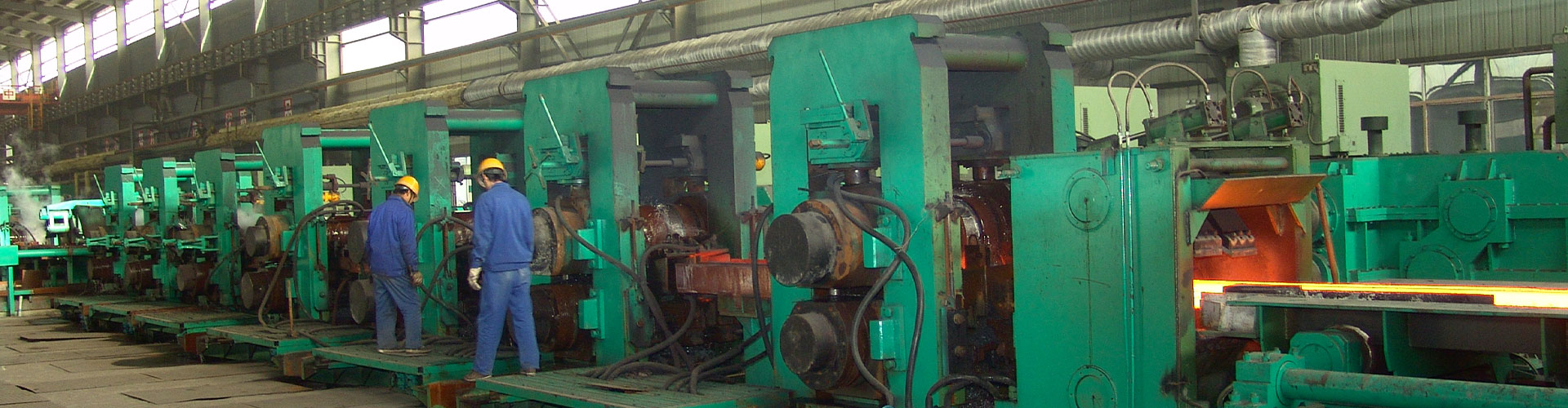
The mill runs two roughing stands and a seven-stand finishing train. One of its target products is high-surface pickled sheet, at more than 700,000 t a year. The defect appeared when the line rolled high-strength pickled thin gauge.
Roll grades split along the train. Stands F1 to F4 carry high-chromium cast iron or high-speed steel rolls. Stands F5 to F7 carry high-nickel-chromium indefinite chill iron. Oxide film spalling concentrated on F2 and F3.
How the Oxide Film Grows
The film grows by oxidation, and its life runs through three stages: formation, growth and breakdown.
In the first stage, oxide weight rises in proportion to time. Once the roll surface oxidises fully, the rate drops sharply. The first film has become a protective layer, so growth follows a parabola against time. At a critical thickness the film starts to fail. From that point the roll surface roughens quickly, and the strip can pick up rolled-in scale from the roll train.
What Sets the Growth Rate
Two things set the rate: roll surface temperature, and the oxidation resistance of the roll material. Film thickness depends on grade and on temperature, and grade carries the larger effect. As the grade moves up, growth slows. A semi-steel roll oxidises faster than a high-chromium roll. A high-chromium roll oxidises faster than a high-speed steel roll.
What Makes the Film Spall
Three factors govern spalling: stress, the bond strength between film and roll, and film thickness. The three connect. Hold the grade and the stress fixed, and the film reaches a fixed critical thickness. Below that thickness it keeps growing slowly. At that thickness it starts to fail. Once it fails it no longer protects the surface, so oxidation speeds up again. Then oxide film spalling and fast regrowth run together, and the strip surface carries scale as a result.
The Two Levers
Grade is a given, so control works on two levers. One is to keep the film thin. The other is to raise its critical thickness. Both keep the film inside the growth stages, below breakdown.
Local Spalling and Overall Spalling
Why spalling stays local
Local spalling points to a film that grew too thick in one area, or to a critical thickness that sat too low there. A film grows too thick when cooling in that area is poor, for example a blocked or worn cooling nozzle, or a spalling-control nozzle in bad condition. Critical thickness falls when local load runs high: local wear, poor local lubrication or poor local water wiping.
Why spalling covers the whole body
Overall spalling comes from several causes at once, so it needs one view across roll temperature, cooling and rolling load. Cooling flow is the main lever on roll temperature. End pressure should reach 98 N, and flow should reach 800 t/(h·m). Because body length and strip width differ, the centre zone needs more flow and the edge zone can take less. Lowering strip temperature also lowers roll temperature. Cependant, it raises rolling load, and the process schedule limits how far that can go. Spalling-control water sits between the two extremes, because it cuts strip surface temperature sharply without changing bulk strip temperature.
Five Measures That Brought It Under Control
Redistribute the load
With grade fixed, load redistribution is the cheapest way to raise critical thickness, and it works best on the stands that spall. On this line overall spalling came with a film that was not especially thick, so a low critical thickness was the real problem. Raising it took priority. On pickled QStE420TM at 2.0 mm × 1250 mm, unit-width rolling load at F2 fell from 25 kN/m to 23 kN/m, and at F3 from 23 kN/m to 21 kN/m. Before the change the line produced 2 à 3 slabs before rolled-in scale appeared on the strip. After it, the line ran 8 slabs or more without a break.
Optimise roll cooling
Film thickness ties to temperature and to time, so cooling works on both. D'abord, raise flow as far as the system allows. Then shift the entry/exit water ratio toward the exit. Enfin, change the flow profile from uniform to parabolic, with more water in the centre and less at the edges.
Optimise the spalling-control water
Spalling-control water cuts the heat that the strip carries into the roll, and its effect shows up in strip surface temperature at the contact point. To get that effect, the nozzles must sit close to the roll and run at higher pressure and flow. This line moved the spray position from 350 mm à 210 mm off the roll centre line. It raised pressure from 0.3 MPa to 1 MPa, and doubled stand water from 30 t/h to 60 ème.
Optimise lubrication rolling
Lubrication rolling lowers rolling load, and a lower load raises critical thickness. Design and maintenance decide whether the effect holds. Top and bottom concentrations need separate control, and so does width control. Getting oil from different lines onto the roll surface at the same moment is difficult, so pipe velocity and flow need attention at the design stage. En outre, one blocked nozzle is enough to lose the effect in that area, and local oxide film spalling follows. Speed changes constantly, and load moves with temperature and speed, so oil concentration needs dynamic control to keep the effect.
Optimise the rolling schedule
Every grade grows its film during a campaign, whether semi-steel, high-chromium or high-speed steel. Once the film passes critical thickness, further rolling brings spalling. High-surface product therefore has to sit inside a defined rolling kilometre budget. From the film’s point of view, hard thin gauge has a low critical thickness, so it needs to run while the film is still thin. That reasoning produced a front-loading strategy: place high-strength pickled thin gauge early in the schedule, directly after the warm-up coils, and use the thin film while it lasts.
What the Line Achieved
With the five measures in place, the mill ran 20 slabs of 2.0 mm high-strength pickled sheet without a break. Pickled output reached 90,000 t a month. The rate of rejects, seconds and downgrades settled inside 3%.
Conclusion
Analysis of the mechanism puts control in two places: slow the growth of the film, and raise its critical thickness. On this line, oxide film spalling now stays largely contained.
Better roll cooling, higher water pressure and an optimised entry/exit distribution raise the cooling effect. Together with spalling-control water and lubrication rolling, they lower strip surface temperature and rolling load.
In scheduling, front-loading thin high-strength high-surface gauge uses the thin film and prevents spalling.