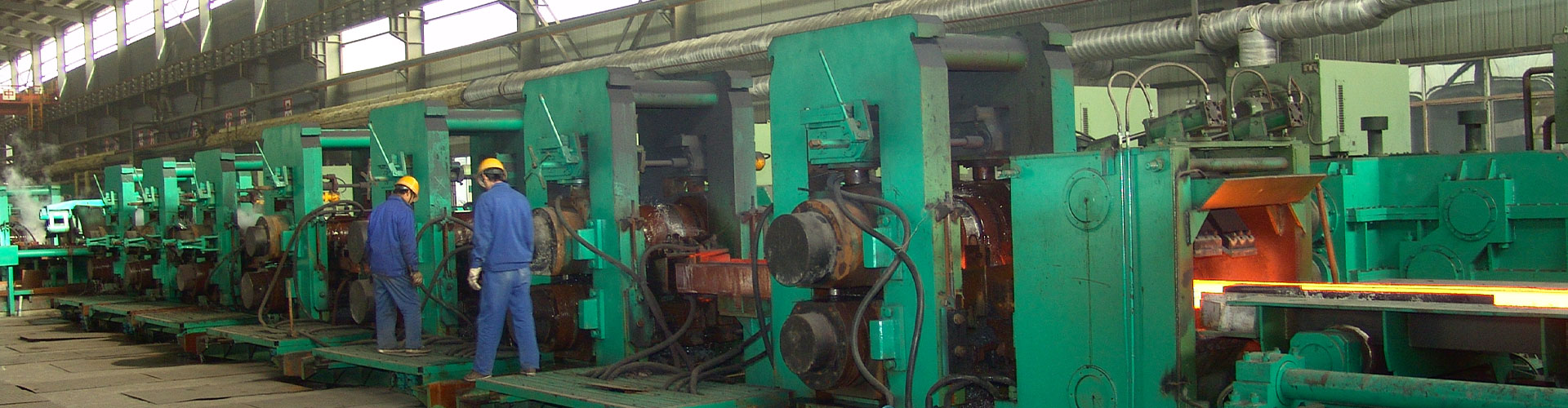
In recent years, the hardness, thermal crack resistance and impact resistance of rolls have been effectively improved by optimizing steel rolling processes and upgrading roll equipment performance. These technical measures reduce roll consumption and extend roll service life. This article mainly analyzes typical roll defects of hot narrow strip steel, including irregular spalling in the middle of roll grooves, roll ring cracking and pitting on roll groove surfaces. Optimized roll cooling solutions are adopted to match the actual production conditions of the production line. Combined with upgraded cooling water supply devices, roll cooling performance can be significantly enhanced. Appropriately increasing roll ring width, selecting suitable roll materials can effectively prevent crack initiation and material spalling.
This technical system can not only correct irregular spalling defects in the middle of roll grooves, but also solve roll ring cracks and pitting problems, improving the stable operation efficiency of rolls.
Rolls are critical components of rolling mills. They directly contact steel blanks and deform the metal under rolling force to achieve the required steel product specifications. Therefore, rolls require high fatigue resistance and wear resistance. With the continuously growing market demand for steel products, excessive roll consumption in rolling production pushes up manufacturing costs. Under such circumstances, extending roll service life, reducing roll replacement frequency and boosting rolling productivity have become key concerns in the metallurgical industry.
Rolls operate under harsh conditions including high temperature, high pressure, alternating hot and cold cycles and oxide scale. The roll barrels of each stand suffer from mechanical stress, friction, thermal stress and impact load, which easily cause wear, cracking and spalling and greatly shorten roll service life. Rolls are high-cost consumables for rolling mills. Roll consumption acts as an important economic indicator of production cost.
## 1 Importance of Extending Roll Service Life
Rolls are high-consumption workpieces that realize continuous plastic deformation of metal on rolling mills, accounting for a large proportion of production expenses. A sound roll management system enables operators to track the status and full service history of every roll. Proper roll matching, reasonable grinding allowance can reduce roll fatigue, ensure rolls meet production requirements, extend roll life and cut unscheduled roll changes. As a result, the production efficiency and economic benefits of rolling lines are improved. The completeness and execution level of roll management system are critical factors to lower production cost and prolong roll service life.
Special personnel shall be assigned for roll management. A complete roll management system should be established to record roll incoming inspection, matching application, crack detection and abnormal roll removal. These measures realize full control over roll status and service track, which is essential to reduce roll consumption and extend roll service life.
## 2 Common Roll Defects in Production
### 2.1 Irregular Spalling at the Center of Roll Grooves
Excessive copper content in the chemical composition at the center area of roll grooves easily triggers irregular spalling. When the central zone of roll grooves is heated, copper migrates on the inner surface of roll grooves. Copper forms low-melting-point phases, which sharply reduce thermal plasticity and induce surface microcracks. With continuous copper migration, cracks expand and eventually cause irregular spalling.
Taking hot narrow strip steel production as an example, inadequate on-site supervision allows finish adjusters to control rolling tonnage of each roll groove freely, leading to uneven wear of different grooves. During roll reconditioning, some microcracks cannot be completely removed by turning. Residual microcracks rapidly propagate and connect after the roll is put back into service, forming macroscopic cracks and causing roll groove spalling.
### 2.2 Roll Ring Cracking
During rolling, roll rings bear combined assembly stress, thermal stress and rolling stress. The total stress on roll rings is the algebraic sum of stress values across the cross-section. The tangential tensile stress on the inner diameter of roll rings is high during operation. Single-material roll rings cannot achieve long service life. Local stress concentration coupled with other loads will damage roll rings and result in cracking.
### 2.3 Pitting on Roll Groove Surface
Pitting, also known as pockmarks, is a common surface defect on roll grooves with rough and uneven appearance. The defect can appear continuously or partially in scattered spots. Pitting is acceptable within a certain limit, but its depth shall not exceed the thickness tolerance of finished products.
Main causes of pitting:
1. Wear or broken iron oxide scale on the exit or previous pass holes;
2. Broken iron oxide pressed and peeled on the surface of rolled stock;
3. Corrosion on roll surface;
4. Severe oxidation on steel blank surface during heating.
### 2.4 Roll Breakage
Impact, tail whipping and steel jamming during rolling generate cracks and soft spots on and inside rolls. Cracks and soft spots severely disrupt normal rolling production and shorten roll service life. Severe cracks will trigger premature roll spalling and lead to early roll failure.
## 3 Root Cause Analysis
These defects are mainly caused by improper manual operation, poor cooling effect, unreasonable rolling process parameters and inherent quality defects of rolls. Inadequate cooling creates large temperature difference on roll surfaces, generating thermal stress that accelerates roll spalling. Excess roll temperature reduces roll strength and wear resistance, resulting in groove bursting, material spalling, thermal cracking and even roll breakage.
Improper roll material selection mismatched with rolled steel grades, or operational faults such as steel wrapping and steel piling also lead to groove damage, spalling and roll fracture.
Metallurgical steel often contains brittle inclusions such as SiO₂, Al₂O₃ and silicates. Such inclusions seriously impair roll service life. The hazard level varies with the quantity, size and type of inclusions. Generally, more and larger inclusions bring greater risks, especially those with sharp edges.
## 4 Process Improvement Measures
### 4.1 Upgrade of Roll Cooling Device
Modifying roll cooling devices improves cooling water utilization and cooling efficiency to extend roll service life. A large amount of heat generates during rolling, so effective cooling is required to control roll temperature and guarantee roll replacement cycle and service life.
The roll cooling system consists of primary and secondary cooling water tanks. Primary cooling water sprays axially to the rolling zone through narrow slits for lubrication and cooling of copper tubes. Secondary cooling rapidly lowers the temperature of rolled tubes, prevents air ingress into the rolling housing and avoids copper tube oxidation. The water spray ring of the cooling device is responsible for roll surface cooling.
During production, the main drive speed exceeds 1300 rpm and the auxiliary roll drive runs above 700 rpm. At such high rotating speed, the flow rate and pressure of cooling water must be strictly controlled. Continuous and sufficient cooling water supply is required. Rolls shall be replaced promptly once overheating occurs to prevent thermal fatigue cracking. In actual production, the cooling flow rate shall be maintained above 3500 L/h, and the water pump pressure shall be kept below 0.8 MPa to stabilize roll temperature.
The original square box structure with holes is replaced by solid cylindrical nozzles. Two rows of elliptical water slits are added at the splitting wedge position, covering a width of 5~8 mm. The water supply for splitting wedge area reaches 3 times that of other regions to strengthen local cooling and improve the service life of roll grooves at splitting wedges.
### 4.2 Optimization of Cooling Water Parameters and Water Supply System
The cooling water temperature must be properly controlled. Excessively high temperature accelerates roll fracture, while too low temperature disturbs recrystallization of rolled tubes and deteriorates product quality. Extreme high or low temperature will accelerate fatigue damage. The recommended cooling water temperature for rolls is 40~60℃.
The cooling water pipeline is reconstructed from low-turbidity water supply to medium-turbidity water supply. Variable frequency motors are adopted for water pumps to realize automatic adjustment of water pressure up to 0.8 MPa.
### 4.3 Optimization of Pass Configuration
Aimed at unsatisfactory cooling effect for φ550 hot narrow strip steel, the pass of stand I is redesigned based on forced spreading principle. Since the temperature of K1 rolled stock is relatively high, the forced spreading passes are arranged on K3 and K4 stands. The groove bottom of forced spreading passes adopts straight line shape. The pass slope is set to 17.7° to avoid wrinkles on rolled stock surface which cause unqualified finished surface. After forced spreading is applied on K3 and K4, the groove dimension of K6 is modified correspondingly to prevent tail pulling defects.
### 4.4 Roll Material Optimization
Taking Q215 hot narrow strip steel as example, the original center distance of roll grooves is 19.0 mm with a middle roll ring width of 7.8 mm, which meets theoretical design indicators. However, the roll ring is still too narrow and prone to fatigue crack and final fracture. Therefore, the roll gap is redesigned to 22.0 mm and the middle roll ring width is adjusted to 10.8 mm.
### 4.5 Retrofit of Automatic Gauge Control System
Rolling force fluctuates with inlet thickness, tension, friction coefficient and deformation resistance. The deformation curve further affects exit thickness. Automatic Gauge Control (AGC) adopts model algorithms to automatically control strip thickness, rolling mill status and external disturbances. It automatically sets rolling force, speed and roll gap to maintain reasonable thickness deviation. AGC system usually matches hydraulic screwdown system, featuring high precision and fast response. The thickness control of rolling line is closely related to slab thickness accuracy, and the number of hydraulic AGC units affects mill precision. For the 6th finishing stand of the steel line, the rough thickness control range is 2.7~27 mm with a tolerance of 10%.
### 4.6 Prevention of Improper Operation
Roll damage caused by improper operation is common in production. Corresponding control requirements are listed as follows:
1. Prevent direct contact between guides and rolls;
2. Strictly follow the operation sequence of cooling water switch to ensure water supply after roll change;
3. Strengthen equipment inspection to avoid steel wrapping. Once steel wrapping occurs, stop the machine immediately and cool the wrapped material to room temperature before disposal;
4. Control the shape of rolled stock strictly according to process specifications and prohibit excessive material deformation in single stand;
5. Fully cut off the black head of rolled stock and avoid rolling black steel.
### 4.7 Sufficient Roll Grinding Allowance
To maintain stable rolling tonnage of each roll groove and eliminate residual cracks, adequate grinding allowance is required. Remaining cracks will reduce rolling output and impair product quality. For Q215 hot narrow strip steel finished rolls, the turning removal amount must reach 0.6 mm. If microcracks still cannot be completely removed after turning, the roll shall be discarded instead of being reused.
## 5 Conclusion
The above process measures can greatly extend roll service life and reduce roll replacement frequency, lowering labor intensity for workers. The solution eliminates irregular spalling in the middle of roll grooves, resolves roll ring cracks and pitting defects. Groove damage induced by thermal cooling is nearly eliminated, product quality is improved and the average effective operation rate of rolling line is increased.