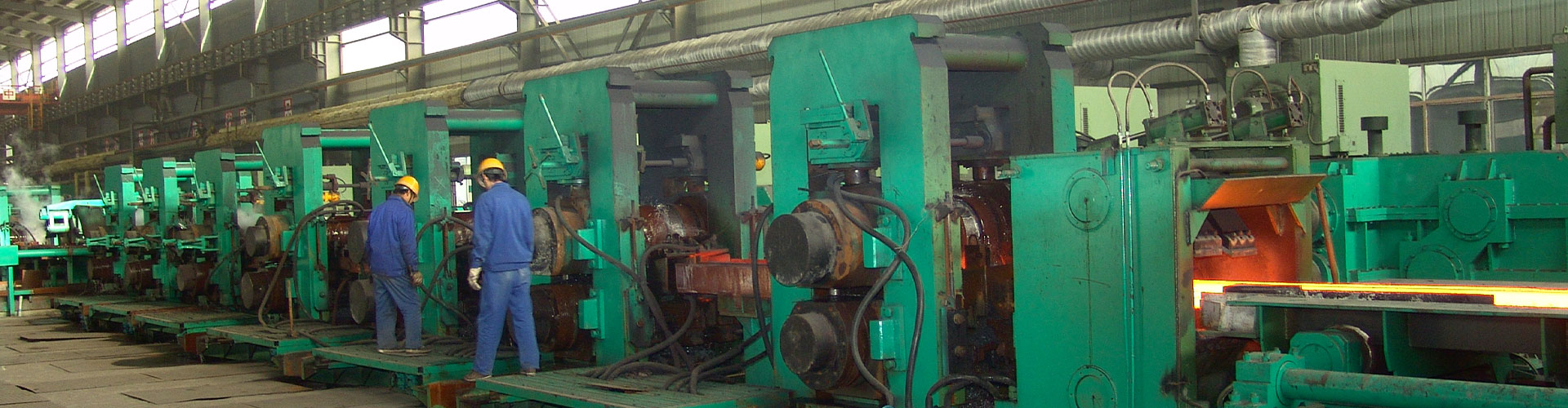
Backup rolls are the largest single category of roll in a rolling mill by consumption. Their job is support: they carry the bending load that would otherwise deflect the work roll, and they hold the stiffness that decides strip profile and thickness accuracy. That supporting role sets every requirement on the roll, from carbon content to hardened depth.
This article therefore follows the hot working route of a forged backup roll, from material selection through steelmaking, fundición, forging and heat treatment. It then sets out the five difficulties that make large forged backup rolls hard to produce.
Why the backup roll sets its own rules
A mill typically carries four or six forged backup rolls. They take the rolling load and preserve work roll stiffness, which reduces work roll bending and improves both profile and gauge.
Size follows from that duty. Backup rolls on a heavy plate mill run 1800 a 2400 mm de diámetro, with maximum rolling force reaching 10,000 t, o 2700 t/m. They see large alternating bending stress in service. Por ejemplo, backup roll diameter on a wide strip mill is generally 1250 a 1630 mm, and the rolling force per unit body length is roughly 400 a 1500 t/m.
Mientras tanto, long rolling contact between work and backup roll generates high shear and contact stress, plus deformation strengthening and wear. The dominant failure modes are therefore spalling and wear. Because a forged backup roll is heavy and its process route is complex, scrap risk is high, and that is why production difficulty concentrates in a handful of areas.
Forged backup roll material selection: Cr2 to Cr5
Primero, a backup roll must deliver wear resistance, accident resistance, surface shear resistance and hardenability. Users keep asking for lower roll consumption and a deeper working layer, and both push hardenability upward.
Respectivamente, the material trend runs from Cr2 to Cr3 and Cr4, then to Cr5. These are medium and high carbon alloy steels with high chromium content, developed from hot work tool steels. They harden and through-harden well. After quenching and tempering, the hardened layer can hold martensite, bainita, pearlite or sorbite.
En la práctica, wear resistance depends on keeping 3% a 9% undissolved carbide in the matrix. Carbon drives strength, dureza, toughness and contact fatigue performance. Raising carbon raises strength and hardness after heat treatment, and lifts the fatigue limit. Past a point, sin embargo, carbon lowers the Ms temperature of martensite and increases retained austenite, which costs hardenability and toughness in the hardened layer. Backup roll carbon is normally held between 0.4% y 1.0%.
Además, chromium is the strongest carbide former in these steels and the most important alloying element. At low chromium content in the high carbon range, chromium dissolves into orthorhombic cementite to form M3C alloy cementite, with a dissolution temperature near 950 °C. Above roughly 2.5% a 3% cromo, M7C3 complex alloy carbide forms, and it can dissolve up to 50% cr. Hardness across the chromium range runs from 1300 a 1800 alto voltaje, and wear resistance rises sharply. Chromium in solution also stabilises austenite, shifts the CCT curve to the right, and improves hardenability and contact fatigue performance.
Además, molybdenum and nickel are added, along with vanadium and titanium. Vanadium forms independent VC precipitates that raise hardness and wear resistance, and it mainly acts to refine grain. Vanadium is generally held between 0.05% y 0.20%. Titanium can be added to form dispersed titanium carbonitride, which further improves wear resistance.
De hecho, field results make the economics plain. Cr4 and Cr5 forged rolls show on-line wear and regrinding allowance at half the level of Cr3 rolls. En otras palabras, a Cr3 roll delivers half the service life of a Cr4 or Cr5 roll of the same size. Plate mills running Cr2 and Cr3 material accept lower hardness, because their service condition is severe: high load, and a demand for spalling resistance, wear resistance and fracture resistance. The Cr2 and Cr3 series meet those requirements and see wide use on plate mills.
Steelmaking and casting
Large ingot size and weight therefore point to double vacuum melting. The route runs electric furnace rough melting, Horno de LF, alloying, VD vacuum refining, then vacuum casting.
Ladle-to-ladle transfer into the refining furnace uses a two-step approach to cut gas content. Argon shielding limits air ingress, and the double vacuum process removes gas from the melt. Hydrogen is held below 2 ppm. The refining furnace draws vacuum once, and casting draws vacuum again.
Entonces, casting uses the AP process to improve internal ingot quality. It reduces segregation of the segregation-prone elements carbon and molybdenum, so C and Mo segregation at riser and nozzle improves noticeably.
Próximo, ingot design follows two conventions for forging stock. Premium forgings use 11% a 12% taper, a height-to-diameter ratio near 1.5, and a riser proportion of 20% a 24%. General forgings use 4% taper, a ratio of 1.8 a 2.3, and a riser proportion of 17%. The body is designed with a polygonal section to suppress corner segregation and promote uniform solidification. Corner count rises with ingot size. A larger body taper improves feeding, reduces segregation, and helps inclusions and gas float out.
Forja
A backup roll is a shaft-type forging. Body length generally runs 1400 a 2300 mm. Backup roll diameter on cold and hot tandem mills is usually 1250 a 1630 mm. Forgings weigh 20 a 70 t, and the ingots feeding them weigh 69 a 119 t.
Diameter is built by upsetting. Compaction depends mainly on the drawing passes, and the drawing compaction pass needs a forging ratio above 2.0.
Cr-type backup roll steel carries high carbon and alloy content, so large amounts of secondary carbide are present. Deformation resistance inside the ingot is high, and the difference between surface and interior resistance makes surface cracking likely. Cracking then undermines compaction.
Production practice at a heavy machinery works resolves the conflict between compaction and surface cracking with high temperature, large reduction, and wide upper and lower V-shaped dies. Simulation and practice show that 135° V-dies of 1210 mm width compact and penetrate the ingot effectively when the die width ratio exceeds 0.61 and single-pass reduction exceeds 22%. Full compaction along the ingot length needs a compaction pass forging ratio above 2.1. Breaking coarse carbide and refining grain requires a final pass forging ratio of 1.5.
Típicamente, three to five forging passes are needed, and the sequence must account for both upsetting and drawing. A flat die with tongs handles upsetting without longitudinal bending, because the ingot height-to-diameter ratio is low. Drawing then uses 135° upper and lower V-dies. The KD method, meaning wide die and large reduction, compacts the billet fully and removes defects. It raises productivity, improves penetration, and lifts internal quality.
Tratamiento térmico
After forging, heat treatment spheroidises the matrix and prepares the structure for the next stage. High temperature normalising, spheroidising anneal and tempering make up that sequence.
Finalmente, preparatory heat treatment adjusts body structure, secures neck hardness, and builds the combined mechanical properties the roll needs. During differential heat treatment, the core stays at austenitising temperature while the surface reaches quenching temperature to a defined depth. After quenching, tensile stress in the core drops markedly, which raises accident resistance.
The five production difficulties
High body hardness. Además, rolling technology and the adoption of high speed steel work rolls keep pushing forged backup roll body hardness up. Domestic production typically delivers HS55 to HS65 at the surface. Overseas production reaches HS70 to HS75, with hardened depth above 50 mm and hardness difference under HS5. Higher hardness improves wear resistance but reduces spalling resistance. High hardness needs high carbon, and high carbon in a cast structure forms network carbide that spalls. Severe segregation or large non-metallic inclusions raise spalling probability further. Faster cooling reaches surface hardness but leaves larger residual stress. A hardened depth above 50 mm also demands real hardenability. Steel grade, forging practice and heat treatment parameters must therefore be solved together, not one at a time.
Hardness uniformity. The measurement method takes hardness at 20 agujas, four directions around the body circumference and five positions along the axis, and requires variation within HS2. Domestic production generally achieves HS3 to HS4. Hitachi achieves HS2. Uniformity traces back to steelmaking, fundición, forging and heat treatment together, not to forging alone. It reflects structural uniformity, chemical segregation control and cleanliness across the whole route.
Hardened depth and residual stress. Technical standards specify a hardness difference of HS5, hardened depth above 50 mm, and residual stress no higher than 500 MPa. Meeting them requires a material with real hardenability and hardenability capacity, plus a complete heat treatment schedule. High temperature annealing relieves residual stress, and differential heat treatment then sets hardened depth and hardness while keeping neck and core toughness.
Metallurgical structure. A sound structure holds surface hardness within a narrow band. The roll should carry a tempered bainite or martensite matrix, with no concentrated or blocky carbide at grain boundaries. Finer grain is better, and carbide should sit as spheroids.
Forging difficulty. Lastly, heavy weight and high carbon make forging hard. Cracking and incomplete core compaction appear readily. Meeting specification therefore requires a complete process discipline covering steel melting, fundición de lingotes, forging heating, forging and heat treatment.
What this means for a roll buyer
En breve, a forged backup roll is a system, not a specification sheet. Carbon between 0.4% y 1.0%, chromium above 2.5% a 3%, a compaction pass forging ratio above 2.1 and a final pass at 1.5 all belong to the same chain. Break one link and the roll still measures within tolerance on delivery, then fails early in service.
The useful question for a supplier is therefore not what hardness the roll reaches, but which forging ratio and which differential heat treatment schedule produced it.