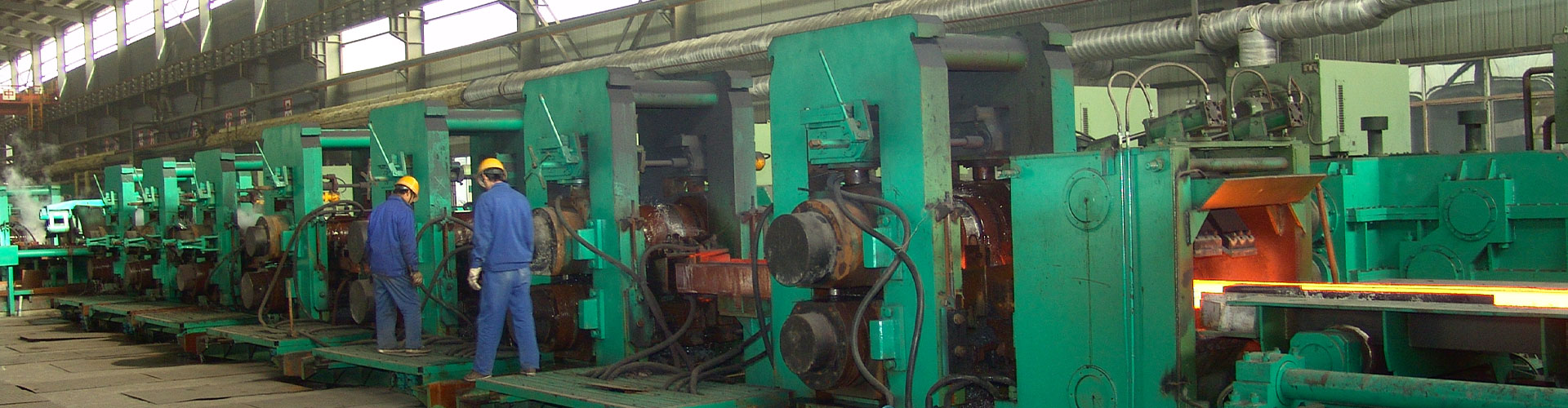
في إنتاج الدرفلة الباردة, rolling rolls directly determine three core production indicators: strip steel output, plate surface quality and steel consumption per ton. Various roll defects occurring during cold rolling will cause batch product downgrade or scrap, reduce product yield, and even lead to severe equipment damage in extreme cases. لذلك, domestic cold rolling enterprises attach great importance to roll application technology research to effectively reduce roll loss and stabilize production efficiency.
Combined with the on-site production practice of stainless steel cold rolling in a steel plant, this article sorts out the common defect types of cold rolling rolls, analyzes the formation mechanism of each problem, and puts forward targeted treatment and prevention measures. In the early commissioning stage of the cold rolling mill, roll surface defects were prominent, which seriously restricted product quality and production rhythm. Typical defects include vibration marks, roll marks, grinding tool marks, cracks and surface spalling, all of which can be directly copied to the strip steel surface and affect the final product quality. In-depth research on defect mechanisms and solutions is of great practical significance for stable cold rolling production.
1. Roll Vibration Marks
Vibration marks refer to alternating bright and dark stripes perpendicular to the strip running direction. On-site verification shows that most strip vibration marks are copied from roll surface vibration defects, which are typical roll-induced quality problems in cold rolling.
1.1 Causes of Roll Vibration Marks
Roll vibration marks with different distribution characteristics correspond to different vibration sources, which can be classified into four typical types:
أولاً, vibration marks caused by grinding wheel spindle vibration, showing a spiral distribution on the roll surface. ثانية, poor grinding wheel dressing and abrasive particle shedding also form spiral vibration marks. The spacing can be calculated by matching roll speed and grinding wheel speed to accurately identify grinding wheel-induced defects.
ثالث, poor contact of roll supporting pads causes vibration marks parallel to the roll generatrix. الرابع, poor tailstock tip shape and abnormal head frame rotation also produce linear vibration marks parallel to the roll generatrix. فضلاً عن ذلك, resonance between the grinding wheel head frame and the main headstock will further aggravate such parallel vibration defects.
1.2 Elimination Methods for Vibration Marks
The core solution is to first investigate and eliminate all abnormal vibration sources. Corresponding grinding processes are selected according to the defect severity. Obvious vibration marks need to be completely removed starting from the rough grinding stage. Slight vibration marks can be eliminated through semi-finish grinding optimization to restore the flatness of the roll surface.
2. Roll Marks
2.1 Manifestations and Root Causes
Roll marks are manifested as pinholes, الخدوش, indentations and pits on the roll surface. Irregular circular dents usually retain the original surface texture, which are mainly caused by foreign metal debris entering the rolling bite area or abnormal contact friction between upper and lower rolls.
Effective preventive measures include cutting off foreign matter sources, thoroughly cleaning the mill housing, optimizing rolling lubrication and cooling conditions, improving the surface quality and trimming quality of pickled coils, increasing the surface hardness and hardened layer depth of work rolls, and reasonably matching the hardness difference between work rolls and intermediate rolls.
2.2 Treatment Methods for Roll Marks
According to the depth and severity of roll marks, surface grinding or precision turning is adopted to completely remove defective layers and restore roll surface accuracy.
3. Grinding Tool Marks (Knife Marks)
3.1 Formation Causes
Tool mark defects are mainly induced by mismatched grinding parameters. Unreasonable coordination of roll rotating speed, grinding wheel speed, Z-axis longitudinal feed speed and grinding depth will leave regular grinding traces. فضلاً عن ذلك, overly sharp grinding wheel edges, local wheel defects, insufficient semi-finish grinding passes, excessive finish grinding load and excessive roll crown are also key factors leading to tool marks on roll surfaces.
3.2 Prevention and Elimination Measures
For prevention, optimize the matching of all grinding parameters to ensure stable and uniform cutting. Chamfer sharp grinding wheel edges and dress defective grinding wheels before operation. Adhere to standardized grinding procedures to completely eliminate rough grinding traces in the semi-finish stage before entering finish grinding. Appropriately reduce finish grinding load, adopt softer grinding wheels or reduce roll crown to avoid tool mark recurrence.
For existing defects, repeated fine grinding is applied to completely remove surface tool marks and ensure uniform roll surface roughness.
4. Roll Cracks
4.1 Crack Formation Causes
Roll cracks are formed under multiple working conditions. Local stress concentration during high-temperature rolling or high-temperature grinding easily induces microcracks. Sudden production accidents such as strip breakage and steel wrapping will directly cause macroscopic roll cracking. Uneven incoming strip thickness leads to instantaneous impact load and sharp fluctuation of rolling force, triggering crack initiation. علاوة على ذلك, long-term cyclic operation will produce typical fatigue cracks on roll surfaces.
4.2 Professional Crack Treatment Methods
To prevent crack propagation from causing secondary defects such as spalling and peeling, all cracks must be thoroughly removed in a timely manner. Mark crack positions at the roll neck for subsequent tracking during grinding. For tiny cracks that cannot be identified by naked eyes after grinding, penetrant testing or magnetic particle testing is required to confirm complete removal before putting the roll into service.
For deep cracks that cannot be eliminated by conventional grinding, fixed-point cutting grinding is adopted to detect crack depth and conduct targeted removal treatment, ensuring no residual crack defects.
5. Roll Spalling and Peeling
Roll spalling refers to the phenomenon of local material separation and falling off from the roll matrix, which is a serious failure mode of cold rolling rolls.
5.1 Roll Surface Spalling
Production accidents including strip breakage, tail flicking and overlapping rolling cause steel jamming and roll slipping, forming severe local thermal impact and surface scorching with concentrated stress. When the cyclic rolling stress exceeds the tensile strength of roll material, surface cracks continue to expand and eventually lead to large-area spalling.
High-cycle fatigue spalling mostly occurs on intermediate rolls and backup rolls without obvious equipment accidents. It belongs to brittle spalling, with crack sources originating under the roll surface. Repeated contact stress induces subsurface fatigue cracks, which expand tangentially along the roll surface and finally penetrate the surface to form peeling defects.
5.2 Roll End Spalling
Abnormal thrust bearing operation, inaccurate positioning or abnormal movement of roll changing trolleys will cause roll end damage during roll replacement. فضلاً عن ذلك, accidental collision during lifting and transportation also leads to roll end chipping and spalling.
5.3 Spalling Treatment Standards
Surface spalling defects must be removed by rough grinding combined with non-destructive testing until no residual defects exist. Slight roll end spalling can be repaired by precision grinding. Rolls with severe end spalling that affects structural strength shall be scrapped directly.
6. Pad Marks (Bracket Marks)
6.1 Formation Causes
Pad marks mainly appear on small-diameter rolls supported by brackets during grinding, including work rolls, first intermediate rolls and second intermediate rolls of 20-high cold rolling mills. Uneven pad surfaces, نتوءات, impure pad materials, or foreign matters such as grinding particles and iron scraps clamped between pads and rolls will scratch the roll surface during grinding and form regular pad marks.
6.2 Elimination Methods for Pad Marks
Laying special pad paper, adopting half-pass grinding or repeated fine grinding processes can effectively eliminate pad marks and restore roll surface smoothness.
7. خاتمة
Cold rolling roll defects are mainly caused by grinding parameter mismatch, equipment vibration, abnormal production operation and fatigue stress. Targeted source control, standardized grinding process, strict accident prevention and precise defect detection are the core measures to solve cold rolling roll problems and treatment difficulties. Scientific daily maintenance and timely defect treatment can effectively improve roll surface quality, extend roll service life, reduce roll consumption, and ensure high-quality and stable operation of cold rolling production lines.