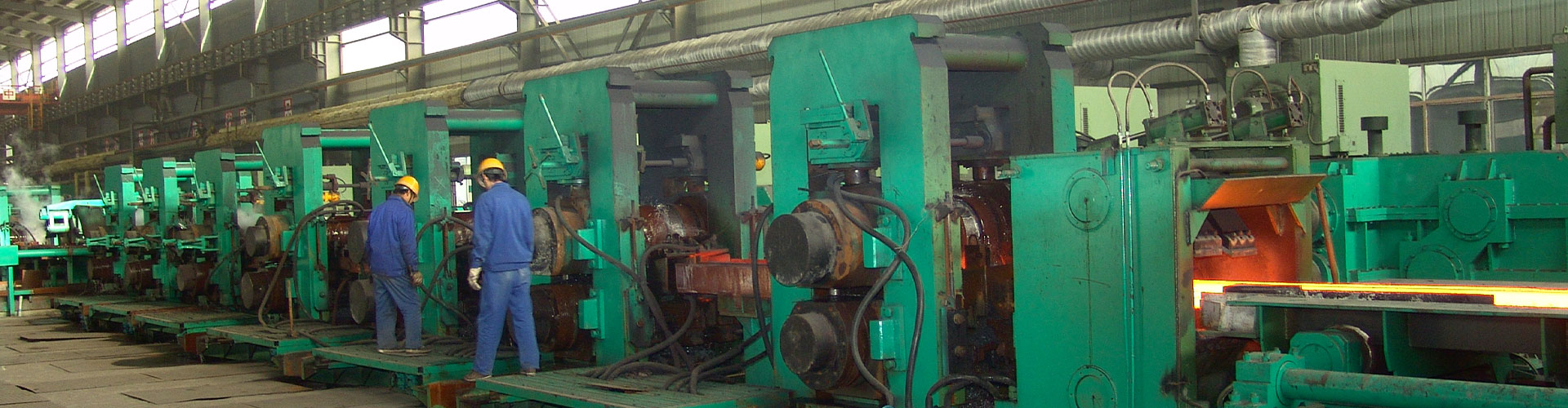
From roughing mill to finishing mill, the impact load gradually decreases, while rolling speed, dimensional accuracy and wear resistance requirements keep rising. The roll design shifts from **high toughness priority** to **high hardness & high wear resistance**. Solid rolls are widely adopted for roughing and intermediate stands, while roll rings are commonly used in pre-finishing, high-speed finishing and reducing & sizing stands. This article compares working conditions, material options, advantages and limitations of rolls in each section of wire rod mill, providing practical reference for metallurgical rolling engineers.
## 1. Working Conditions & Material Requirements of Each Rolling Zone
### مطحنة التخشين
Large billet cross-section, heavy reduction, strong biting impact, severe damage from steel jamming accidents. Workpiece temperature is the highest with drastic thermal cycling and prominent thermal fatigue.
Core priority: impact resistance and thermal crack resistance to guarantee stable biting; wear resistance is secondary.
Main materials: alloy semi-steel, آدميت, pearlitic ductile iron.
ملحوظة: High chromium rolls are not recommended here. Steel jamming will cause massive spalling on roll body if high chromium rolls are used blindly, leading to huge economic losses.
### مطحنة متوسطة
Workpiece size reduces, impact load decreases, more rolling passes. Pass wear directly affects the shape of incoming stock for downstream stands.
Requirement: balanced toughness and wear resistance, uniform pass wear.
Main materials: ductile iron, الحديد الزهر البارد إلى أجل غير مسمى. Centrifugal composite high chromium cast iron is an alternative for alloy steel production lines.
القيد: Ordinary ductile iron suffers fast wear when rolling spring steel and Cr-Mo alloy steel, which will cause stock deviation and easily trigger subsequent steel jamming.
### مطحنة ما قبل التشطيب
Transition section with obviously increased rolling speed. Stable stock shape and dimension are critical to create good conditions for finishing mill.
Requirement: مقاومة التآكل العالية, good hot hardness, no easy surface spalling.
Main materials: high nickel-chromium indefinite chill cast iron, high chromium roll rings; high-speed steel roll rings have been applied in many new production lines.
ملحوظة: Excessively high hardness will cause ring cracking under minor steel jamming or steel wrapping. Poor cooling will rapidly induce thermal cracks on roll surface.
### مطحنة التشطيب & Reducing-Sizing Mill
Highest rolling speed. Finished dimension and surface quality are the core targets. Small deformation with almost no heavy impact.
Requirement: ultra-high wear resistance, excellent hot hardness, long-term stable pass geometry to ensure wire surface quality.
Main materials: كربيد التنغستن (hard alloy) roll rings; high-speed steel roll rings are adopted in partial stands.
القيد: Poor impact resistance. Roll rings will crack instantly once steel jamming or foreign object collision occurs. Strict requirements on cooling system, guides and incoming material quality.
## 2. Detailed Analysis of Each Rolling Section
### 2.1 مطحنة التخشين
Solid roll structure. The first pass bears heavy impact from hot billet.
Toughness cannot be sacrificed even if pass wear rate is relatively fast. Semi-steel and ductile iron are still kept in many old lines for accident resistance.
– After steel jamming, the roll can be repaired by re-turning instead of direct scrapping.
### 2.2 مطحنة متوسطة
Serves as the link between roughing and finishing. Most surface defects and stock shape issues originate from uneven pass wear in intermediate stands.
For lines rolling alloy steel and high carbon steel, the rear intermediate stands are gradually upgraded to high chromium rolls to extend roll change cycle.
### 2.3 مطحنة ما قبل التشطيب
A transition segment often overlooked on site.
Pass wear in pre-finishing mill causes stock fluctuation, which accelerates consumption of finishing roll rings and degrades finished surface quality.
Many new production lines upgrade pre-finishing rolls to high-speed steel roll rings, whose performance sits between high chromium cast iron and hard alloy.
### 2.4 التشطيب & Reducing-Sizing Mill
Tungsten carbide roll rings are the iconic configuration of high-speed wire rod mills.
– Extremely high hardness, huge steel throughput per groove, nearly unchanged pass profile, stable finished dimension and surface condition
– High brittleness, sensitive to impact, thermal shock and steel jamming
– Roll rings may shatter once folded incoming material or foreign particles enter, bringing high replacement cost
## 3. Industry Consensus
1. Higher price or hardness does not equal better performance. The whole rolling line shall match the steel grades being rolled, including plain carbon steel, weathering steel, spring steel and alloy structural steel.
2. Even premium roll materials will quickly form network thermal cracks and subsequent spalling if cooling is uneven.
3. Thermal cracks generated on roughing and intermediate rolls will be inherited and finally form surface defects on wire rods in downstream stands.
4. For alloy steel and spring steel production, all stands along the line need synchronous upgrade. Upgrading only finishing roll rings achieves limited improvement.
## 4. خاتمة
Roughing mill focuses on impact resistance; intermediate mill stabilizes stock shape; pre-finishing mill acts as transition control; finishing mill relies on hard alloy rolls to guarantee finished product quality. Reasonable roll material matching for each stand reduces roll consumption, lowers downtime and improves wire rod quality.
Meta Description: Compare roughing, متوسط, pre-finishing and finishing roll material selection for wire rod mill. Learn working conditions, material options, pros & cons of alloy semi-steel, ductile iron, high chromium, HSS and tungsten carbide roll rings.